Neither side have added significantly to their squads over the summer - though goalkeeper Petr Cech will make his Arsenal debut against his old side.
Chelsea could hand a start to new signing Radamel Falcao.
Falcao, 29, spent last season with Manchester United but endured a poor campaign, scoring just four goals in 29 games.
He signed a season-long loan deal from Monaco earlier this summer, while Chelsea's only other signing is goalkeeper Asmir Begovic from Stoke.
He replaces Cech, 33, who played 494 games in 11 seasons at Stamford Bridge before his £10m move in June.
Chelsea manager Jose Mourinho has confirmed that striker Diego Costa (hamstring) and defender Gary Cahill (nose) are both fit after pre-season injury concerns.
A rivalry renewed: Wenger v Mourinho
Sunday sees two Premier League giants collide, with Arsenal boss Arsene Wenger hoping to beat a side managed by Jose Mourinho for the first time.
Wenger is yet to taste victory against Mourinho in 13 attempts and the two managers have already been involved in one disagreement this summer.
Mourinho suggested that Arsenal had spent more money than Chelsea over the last few years, with Wenger responding by saying he "does not listen to what people think or say".
On Friday Mourinho repeated his belief that Arsenal can mount a serious title challenge this season but played down his rivalry with Wenger.
He said: "It doesn't matter about Arsenal, it doesn't matter about the manager.
"I never made it an explosion of happiness or special pride in my victories over Arsenal. I do not make a drama if one day we lose."
In return Wenger light-heartedly suggested the media favour Mourinho: "I'll leave your love story with him to continue without interfering.
"I wouldn't like to interfere in that."
When challenged that Mourinho believes it is Arsenal who receive preferential treatment, Wenger replied: "So it's all about love."
Arsenal - who have not scored against Chelsea in over eight hours of play - did win last season's Community Shield - beating Manchester City 3-0 at Wembley.
Pre-season form
Arsenal have been in fine form this summer, and have already won two pre-season tournaments.
A highlight has been the emergence of youngsters Jeff Reine-Adelaide and Alex Iwobi - nephew of former Bolton and Hull midfielder Jay-Jay Okocha.
Chelsea have spent a mixed pre-season in the United States.
Begovic was beaten four times in a "tired" display as Jose Mourinho's side lost 4-2 to New York Red Bulls, before draws with Paris St-Germainand Barcelona - both of which the Blues won on penalty shootouts.
Chelsea begin their Premier League defence against Swansea on Saturday, 8 August (17:30 BST), while Arsenal face West Ham at 13:30 the next day.
Does the Community Shield set the tone?
2014: Arsenal 3-0 Manchester City
A comfortable win for the Gunners. Arsenal went on to retain the FA Cup and finish third in the Premier League, four points behind runners-up City. Chelsea won the title by eight points.
2013: Manchester United 2-0 Wigan
The first game of David Moyes's short reign at Old Trafford was not a sign of things to come. Moyes was sacked at Easter as champions United finished in seventh place - their worst Premier League season. Manchester City were champions as FA Cup holders Wigan went on to lose in the Championship play-offs.
2012: Chelsea 2-3 Manchester City
In a game played at Villa Park thanks to the Olympics in London, Samir Nasri hit the winner for champions City. Chelsea would sack Roberto Di Matteo before Christmas and City would also part company with their Italian manager, Roberto Mancini, at the end of the season after losing the FA Cup final to Wigan. Manchester United were champions in Sir Alex Ferguson's final campaign.
2011: Manchester City 2-3 Manchester United
Nani's stoppage-time winner gave Manchester United a win over rivals City, but Roberto Mancini's side were smiling nine months later as Sergio Aguero's famous last-gasp goal gave them their first league title in 44 years, denying United on goal difference.
2010: Chelsea 1-3 Manchester United
Manchester United were too good for Chelsea, a pattern that would repeat itself over the course of the season. Sir Alex Ferguson's men were champions again, beating the Blues by nine points and prompting owner Roman Abramovich to fire Carlo Ancelotti 12 months after winning the double.
The key Wembley stats
The FA Cup winners have only won one of the last five Community Shield matches - Arsenal last year.
The last two times Chelsea have won the Community Shield, they have gone on to win the title (2005 and 2009).
These sides have met once previously in the Community Shield, Chelsea winning 2-1 in 2005. Cesc Fabregas, now at the Blues, scored Arsenal's goal that day.
This will be the Gunners' 21st appearance in the Community Shield. They've won it outright 12 times, losing seven (twice on penalties) and shared it once.
Chelsea will be making their 11th appearance in the event. They've won it four times (once on penalties), losing the other six (twice via penalty shootout).
The last five Community Shield games have produced a total of 19 goals.
The last time a side that won the Community Shield went on to win the league title was in 2010 (Manchester United).
Arsene Wenger has never beaten Jose Mourinho in 13 attempts (D6 L7).
Chelsea are unbeaten in their last eight meetings with Arsenal (W5 D3).
The Gunners have gone 482 minutes without a goal against Chelsea.
A successful trial of a vaccine against ebola is being seen as pivotal in the fight against infectious diseases.
Analysis of the drug found that it was 100% effective when used in certain conditions in Guinea.
An outbreak of the disease caused the deaths of more than 11,000 people in the sub-Saharan countries of Guinea, Liberia and Sierra Leone.
The VSV-EBOV (Merck, Sharp & Dohme) vaccine was tested on communities where ebola had broken out to see if it helped to prevent the disease spreading.
Around 4,000 people who were close to victims - called a "ring" due to the the way they often surrounded people affected - were given the treatment to see if it offered protection.
Video:Nurse Just Wanted To 'Get Job Done'
Scientific research published in the Lancet and released by the World Health Organisation found that VSV-EBOV had proved "highly effective".
It was also tested on a small number of frontline workers with the charity Medicins Sans Frontieres (MSF) who have been involved in treating those with the illness.
Its success means that WHO is planning to roll it out to other frontline workers and it is due to be trialled on children, having been deemed safe for adults.
Those involved in funding the trial called it a "remarkable" result and said the co-operation between organisations and countries that allowed it to come about augured well for future outbreaks of dangerous viruses.
Video:January: Inside Sierra Leone Clinic
Jeremy Farrar, director of the UK-based Wellcome Trust, one of the funders of the trial, said: "This partnership also shows that such critical work is possible in the midst of a terrible epidemic.
"It should change how the world responds to such emerging infectious disease threats."
Assistant director-general Marie-Paule Kieny, who leads the Ebola Research and Development effort at WHO, added: "This record-breaking work marks a turning point in the history of health R&D (research and development).
"We now know that the urgency of saving lives can accelerate R&D.
Video:Sky Wins BAFTA For Ebola Coverage
"We will harness this positive experience to develop a global R&D preparedness framework so that if another major disease outbreak ever happens again, for any disease, the world can act quickly and efficiently to develop and use medical tools and prevent a large-scale tragedy."
Phil Jones and Daley Blind
were both at the launch party
in Manchester and showed off
how the kit looks when on the
players.
With shoulder stripes kicking
back to the Adidas kits of the
1980, there’s plenty of retro
inspiration in Man United’s
new kit for this season.
As well as Jones and Blind
being at the event to promote
the kit, a host of United stars
including Juan Mata, Ander
Herrera and Bastain
Schweinsteiger all took part in
the build-up to the campaign
launch.
Adidas created plenty of hype
around the kit launch, to the
point where it almost felt like
a new player was going to be
announced, which was a bit
intense but fans will overall
be quite happy with the new
kit.
It’s a refreshing change from
Nike having had them as the
kit manufacturer for so long
and it will be interesting to
see what they do with the
away and third kits.
Facebook founder Mark Zuckerberg and wife Priscilla Chan have revealed that they are expecting a baby girl! The billionaire tech entrepreneur and his doctor wife also revealed that they suffered multiple miscarriage prior to this pregnancy. As you might imagine, the announcement was made via Facebook!
Read below;
Priscilla and I have some exciting news: we’re expecting a baby girl! This will be a new chapter in our lives. We’ve already been so fortunate for the opportunity to touch people’s lives around the world — Cilla as a doctor and educator, and me through this community and philanthropy. Now we’ll focus on making the world a better place for our child and the next generation. We want to share one experience to start. We’ve been trying to have a child for a couple of years and have had three miscarriages along the way.
You feel so hopeful when you learn you’re going to have a child. You start imagining who they’ll become and dreaming of hopes for their future. You start making plans, and then they’re gone. It’s a lonely experience. Most people don’t discuss miscarriages because you worry your problems will distance you or reflect upon you — as if you’re defective or did something to cause this. So you struggle on your own.
In today’s open and connected world, discussing these issues doesn’t distance us; it brings us together. It creates understanding and tolerance, and it gives us hope. When we started talking to our friends, we realized how frequently this happened — that many people we knew had similar issues and that nearly all had healthy children after all. We hope that sharing our experience will give more people the same hope we felt and will help more people feel comfortable sharing their stories as well.
Our good news is that our pregnancy is now far enough along that the risk of loss is very low and we are very hopeful. Cilla and our child are both healthy, I’m extremely excited to meet her and our dog Beast has no idea what’s coming. In our ultrasound, she even gave me a thumbs up “like” with her hand, so I’m already convinced she takes after me. We’re looking forward to welcoming her into the world and sharing more soon when she’s ready to come out and meet everyone!
AS the Times Higher Education (THE) Africa universities summit kicked off July 30 at the University of Johannesburg, South Africa, the main buzz of the event was the landmark unveiling of a new African university ranking.
And it’s here, just released Friday, though only ranking the top 30 of Africa’s approximately 2,600 higher education institutions. THE Africa University Ranking
1. University of Cape Town (South Africa) 2. University of the Witwatersrand (South Africa) 3. Makerere University (Uganda) 4. University of Stellenbosch (South Africa) 5. University of KwaZulu-Natal (South Africa) 6. University of Port Harcourt (Nigeria) 7. University of the Western Cape (South Africa) 8. University of Nairobi (Kenya) 9. University of Johannesburg (South Africa) 10. Universite Cadi Ayyad (Morocco) 11. University of Pretoria (South Africa) 12. University of Ghana (Ghana) 13. University of South Africa (South Africa) 14. Suez Canal University (Egypt) 15. Universite Hassan II (Morocco) 16. Addis Ababa University (Ethiopia) 17. Rhodes University (South Africa) 18. University of The Free State (South Africa) 19. North West University (South Africa) 20. University of Tunis (Tunisia) 21. Ecole Nationale d'Ingenieurs de Sfax (Tunisia) 22. Universite Mohammed V - Agdal (Morocco) 23. American University in Cairo (Egypt) 24. Nelson Mandela Metropolitan University (South Africa) 25. South Valley University (Egypt) 26. Alexandria University (Egypt) 27. Assiut University (Egypt) 28. University of Sfax (Tunisia) 29. University of Yaounde (Cameroon) 30. Minia University(Egypt)
These results are essentially based on the amount of citations there are for the university’s work. They are derived from the methodology for the current world university ranking, using the 13 factors (below), combining THE’s own enormous database of statistics along with the Elsevier’s Scopus database - a system that highlights some of the continent’s top performers in terms of how often research papers are referred to and cited by other academics globally. This methodology is designed for the research-led globally facing university. Times Higher Education emphasised that not everyone in Africa will find the metrics appropriate to their mission or their strategic priorities making this ranking a starting point of a longer, inclusive conversation involving African institutions. One of the big surprises was the omission of several African universities that have consistently featured high up on global ranking lists. Namely; Cairo University, University of Ibadan, University of Nigeria and Al-Azhar University in Egypt.
The other surprise was the appearance of unexpected or lesser-known institutions, such as the Universite Cadi Ayyad (10), Port Harcourt (6), the Universite de Sfax in Tunisia (28), Universite Hassan II (15) and several other institutions from Egypt namely; Suez Canal University (14), South Valley University and Minia University (30) . In an interview with M&G Africa, Phil Batty - Editor of the Times Higher Education World University Rankings - explained that even though they have spent the last 4-5 years modifying and refining a methodology that would be better suited to an African, as opposed to a global, ranking - “there’s still a long way to go”. He said that what THE has “created is a snapshot of research strength”.
Batty was also candid about the lack of extensive data in creating this first THE Africa university ranking. That this is “the very start of the story. [Because] world rankings are driven by research, innovation and tech development, we need to work with African universities on [indicators such as] their teaching and graduate success…the rankings we’re publishing are actually very much the starting point. We want to use this conference to convince universities to start collecting and sharing data more consistently.”
The build up
The ranking comes at a time when Africa’s universities are looking to experience a period of revitalisation, with a booming middle class and concentrated pan-African efforts - such as the Higher Education Summit in Senegal earlier this year - aimed at addressing their challenges. Yet, African universities have become lost in global rankings - measured against institutions in the rich, developed world which continue to dominate the leagues and without focused efforts that look to finding metrics which are appropriate to the African context.
One of the key actors in the creation of this Africa ranking is the University of Johannesburg.
In an interview with M&G Africa, Professor Ihron Rensburg - the Vice-Chancellor and principal of the University of Johannesburg - explained that, as part of the University’s 10th anniversary, they engaged THE to say “we have an apparently shared ambition, first you have a series of conferences where you create the opportunity for universities to reflect, [engage in] dialogue and debate on the state of universities in order to ramp up excellence in teaching and learning and research – we as the University of Johannesburg – share that driving ambition and that is important for us that Africa’s universities pursue global excellence and stature in internationalisation, collaboration, teaching and research.”
He emphasised that the University of Johannesburg “effectively founded and conceptualised the idea and asked [THE] to do it jointly – [bringing] together our driving ambition and creating a forum for African Universities to debate and dialogue.”
The president has asked US scientists to build the fastest supercomputer
President Obama has signed an executive order calling for the US to build the world's fastest computer by 2025.
The supercomputer would be 20 times quicker than the current leading machine, which is in China.
It would be capable of making one quintillion (a billion billion) calculations per second - a figure which is known as one exaflop.
A body called the National Strategic Computing Initiative (NSCI) will be set up to research and build the computer.
The US is seeking the new supercomputer, significantly faster than today's models, to perform complex simulations, aid scientific research and national security projects.
It is hoped the machine would help to analyse weather data for more accurate forecasts or assist in cancer diagnoses by analysing X-ray images.
A blog post on the White House website also suggests it could allow NASA scientists to model turbulence, which might enable the design of more streamlined aircraft without the need for extensive wind tunnel testing.
Such a computer would be called an exascale machine.
Bigger models
Richard Kenway at the University of Edinburgh says he thinks the plan is "spot on" in terms of strategy, bringing together both the ambition to develop new hardware and also improved analysis of big data.
He explained the computer could aid the development of personalised medicines, tailored to specific individuals.
"Today, drugs are designed for the average human and they work OK for some people but not others," he told the BBC.
"The real challenge in precision medicine is to move from designing average drugs to designing drugs for the individual because you can know their genome and their lifestyle."
There could also be benefits in long-term climate modelling, according to Mark Parsons at the Edinburgh Parallel Computing Centre (EPCC).
Currently, climate scientists attempt to model how the Earth's climate will evolve in coming years, but the accuracy of these predictions is severely limited.
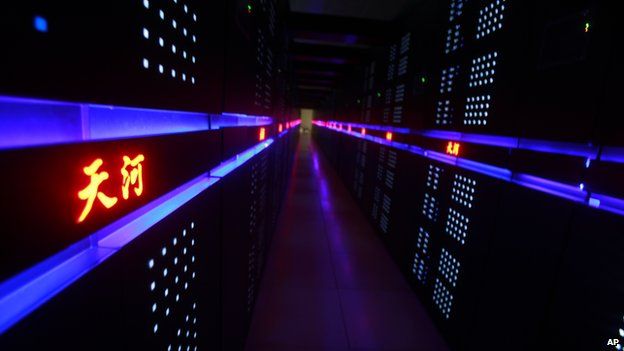
The Chinese currently own the world's fastest computer.
Today's fastest supercomputer, the Tianhe-2 in China's National Computer Centre, Guangzhou, performs at 33.86 petaflops (quadrillions of calculations per second), almost twice as fast as the second-quickest machine, which is American.
For Parsons, the latest US initiative is a clear attempt to challenge the dominance of the Chinese in this field.
"The US has woken up to the fact that if it wants to remain in the race it will have to invest," he told the BBC.
£60m electricity bill
Both Kenway and Parsons point out that the challenges of building an exascale computer are not trivial and would require years of research and development.
Chief among the obstacles, according to Parsons, is the need to make computer components much more power efficient. Even then, the electricity demands would be gargantuan.
"I'd say they're targeting around 60 megawatts, I can't imagine they'll get below that," he commented. "That's at least £60m a year just on your electricity bill."
Efforts to construct an exascale computer are not entirely new.
Recently, IBM, the Netherlands Institute for Radio Astronomy (ASTRON) and the University of Groningen announced plans to build one to analyse data from the Square Kilometre Array (SKA) radio telescope project.
SKA will be built in Australia and South Africa by the early 2020s.